
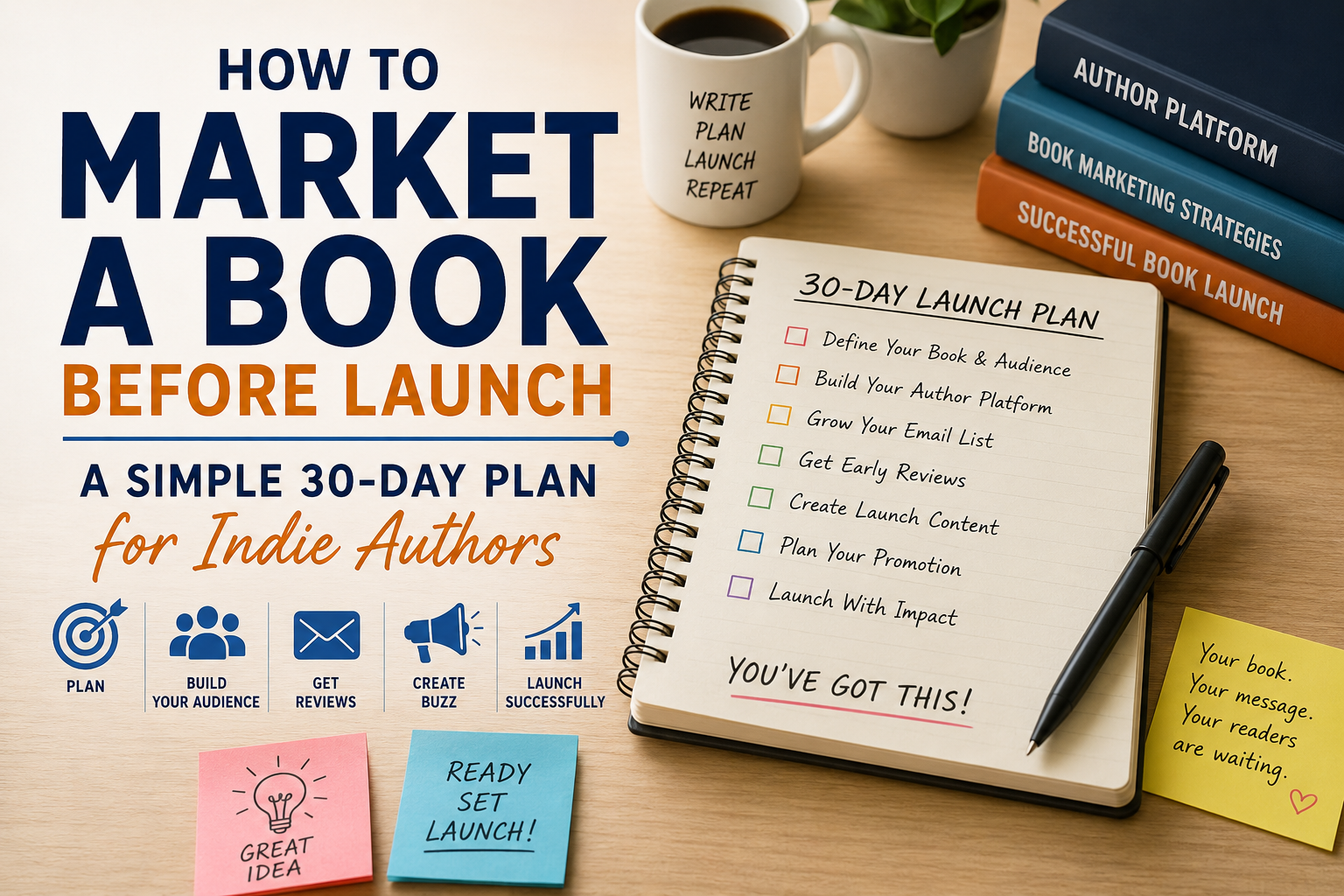
How to Market a Book Before Launch: A Simple 30-Day Plan for Indie Authors
Publishing a book is a major accomplishment but releasing it quietly and hoping readers find it is one of the most common mistakes indie authors make.
A successful book launch does not begin on release day. It begins weeks earlier, when you start preparing your message, audience, review strategy, sales page, email list, and promotional assets.
The good news is that you do not need a massive audience to launch well. You need a clear plan, a consistent message, and enough runway to give your book a real chance to be noticed.
This 30-day book marketing plan is designed for indie authors who want a practical, manageable approach to promoting a book before launch.
Whether you are releasing your first book or adding another title to your catalog, the goal is simple: build awareness before release day so your book does not arrive to silence.
Why Book Marketing Should Start Before Launch
Need help planning your book launch?
AuthorsBookLaunch.com helps indie authors prepare launch campaigns, author spotlights, promotional copy, and book visibility assets.
Many authors wait until their book is live before thinking about marketing. By then, they are already behind.
Pre-launch marketing helps you:
- Introduce your book to potential readers
- Prepare early reviewers
- Build anticipation
- Improve your sales page and metadata
- Create shareable promotional materials
- Give readers a reason to care before launch day
- Avoid the panic of last-minute promotion
A book launch is not just a date. It is a sequence of small actions that create visibility.
The more you prepare before launch, the more confident and organized your release will feel.
Need help planning your book launch? Visit AuthorsBookLaunch.com for book launch support, author spotlight opportunities, and launch campaign guidance.
The 30-Day Book Marketing Plan
This plan assumes your manuscript is nearly ready, your cover is complete or close to complete, and you have a release date in mind.
If your book is not formatted, your description is unfinished, or your publishing files are not ready, handle those first. Marketing works best when the book itself is prepared for readers.
For publishing preparation help, you may also want to review your book’s readiness before launch through Books2Publish or eBooksLaunch.
Days 1-5: Clarify Your Book Positioning
Before you promote your book, you need to know how to describe it clearly.
Many authors struggle with marketing because they are too close to the book. They know the story, the research, the characters, the argument, or the emotional journey, but they do not yet have a simple reader-facing message.
During the first five days, focus on positioning.
Define the Core Reader
Ask yourself:
- Who is this book for?
- What type of reader will enjoy or need it most?
- What problems, escape, emotions, or experiences does the book provide?
- What other books might this reader enjoy?
- Why would someone choose this book now?
For fiction, think in terms of genre, mood, tropes, emotional promise, setting, and reader expectations.
For nonfiction, think in terms of problem, transformation, credibility, practical value, and urgency.
Write a One-Sentence Book Hook
Your hook should explain the book quickly.
For fiction:
A retired detective returns to his hometown after a cold case resurfaces and threatens the people he once failed to protect.
For nonfiction:
A practical guide for first-time indie authors who want to publish professionally without getting overwhelmed by the process.
Your hook does not need to explain everything. It needs to make the right reader lean in.
Tighten Your Book Description
Your book description should not read like a summary. It should read like an invitation.
A good description usually includes:
- A strong opening hook
- The main character, problem, or promise
- The stakes or benefit
- The tone or genre expectation
- A closing reason to buy or read
Do not try to explain every subplot or chapter. Readers need clarity, not a full report.
Days 6-10: Prepare Your Author Platform
Your author platform does not need to be huge, but it should be functional.
At minimum, readers should be able to find out who you are, what your book is about, and where to follow or contact you.
Update Your Author Website or Landing Page
Your author’s website should include:
- Your author bio
- Book cover
- Book description
- Preorder or launch link
- Email signup
- Contact information
- Social links
- Press or media information if relevant
If you do not have a full author website, create a simple landing page. One clear page is better than a complicated site that never gets finished.
Create or Refresh Your Author Bio
Prepare three versions:
- Short bio: 50 words
- Medium bio: 100–150 words
- Long bio: 250–300 words
You will use these for your website, media pitches, author profiles, guest posts, podcast outreach, book listings, and press materials.
Set Up an Email Signup
Email is still one of the most valuable tools an author can build.
You do not need a large list to begin. You need a way to capture interested readers.
Offer something simple:
- Sample chapter
- Launch notification
- Bonus Scene
- Printable checklist
- Resource guide
- Reader update list
For nonfiction, a checklist or short resource guide works well.
For fiction, a bonus scene, prequel story, character guide, or sample chapter can work well.
If you need help building the foundation around your book, visit AuthorsLaunchpad.com to build your author platform.
Days 11-15: Build Your Review and Outreach List
Reviews are one of the most important forms of early credibility.
You should not wait until launch day to start thinking about them.
Identify Early Readers
Make a list of people who may be willing to read and review your book.
Possible early readers include:
- Newsletter subscribers
- Beta readers
- Writing group members
- Genre readers
- Book bloggers
- Podcast hosts
- Local media contacts
- Fellow authors
- Professional colleagues
- Book club organizers
Do not pressure people. Invite them clearly and respectfully.
Prepare a Review Request Message
Keep it simple:
- Introduce the book
- Explain why you are reaching out
- Offer a review copy
- Mention the launch date
- Explain where reviews help most
- Thank them whether or not they participate
Do not ask for only positive reviews. Ask for honest reviews.
Create a Simple ARC Tracker
Track:
- Name
- Email
- Date contacted
- Book sent
- Follow-up date
- Review posted
- Review link
- Notes
A spreadsheet is enough.
The point is to stay organized.
Days 16-20: Create Launch Content
Now begin creating the content you will use around launch.
Do not try to create everything from scratch during launch week. Prepare it now.
Create Your Core Launch Assets
You should have:
- Book description
- Author bio
- Book cover image
- Author photo
- Short book hook
- Launch announcement
- Email announcement
- Social posts
- Press release or media pitch
- Review request message
- FAQ or talking points
If you have these ready before launch week, the actual launch becomes much easier.
Write 3–5 Supporting Posts
These can be blog posts, newsletter articles, or guest post ideas.
For fiction:
- The inspiration behind the book
- Why readers love this genre
- A guide to the setting or world
- Character spotlight
- Themes behind the story
For nonfiction:
- A problem your book solves
- A practical checklist from the book
- A behind-the-scenes author story
- Common mistakes your readers make
- A short lesson or framework from the book
These posts help readers understand why your book matters.
Prepare Social Media Content
Create at least 10 short posts.
Mix them up:
- Book cover reveal
- Quote or excerpt
- Author story
- Launch countdown
- Reader benefit
- Behind-the-scenes note
- Review request
- Launch day announcement
- Thank you post
- Final reminder
You do not need to be everywhere. Pick the platforms where you are most likely to show up consistently.
Days 21-25: Strengthen the Sales Path
Before sending traffic to your book, make sure the sales path is clear.
A confusing sales path loses buyers.
Check Your Book Page
Make sure your book page includes:
- Clear title
- Cover image
- Strong description
- Author name
- Buy/preorder button
- Format options
- Reader benefit or hook
- Author bio
- Review snippets if available
- Email signup or follow option
If the page feels confusing, simplify it.
Check Your Metadata
Your metadata helps readers and retailers understand your book.
Review:
- Subtitle
- Keywords
- Categories
- Description
- Author bio
- Series information
- Age range if relevant
- BISAC/category choices
- Comparable titles if used in marketing
Metadata is not glamorous, but it matters.
Create a Launch Week Link List
Prepare one document with every important link:
- Amazon page
- Book website
- Author website
- Goodreads page if used
- BookDiscoveryNetwork listing
- Newsletter signup
- Press release
- Social profiles
- Review links
This prevents scrambling later.
Before launch, make sure your files, metadata, and publishing setup are ready. You can use Books2Publish.com to prepare your book for publishing or eBooksLaunch.com to prepare your ebook for launch.
Days 26-30: Launch Week Preparation
The final five days are about visibility, reminders, and execution.
Send Your Warm-Up Email
Let your list know the launch is coming.
Keep it simple:
- Remind them of the book
- Tell them the launch date
- Explain who the book is for
- Share why it matters
- Invite them to follow, preorder, review, or share
Follow Up with Early Readers
Authors who want a visibility boost can also submit their book for discovery through BookDiscoveryNetwork.com.
Send a polite reminder to ARC readers and early supporters.
Include:
- Launch date
- Review link if available
- Thank you note
- Simple instructions
Do not guilt people. Make it easy for them to help.
Schedule Launch Posts
Schedule or draft your launch-day posts ahead of time.
Include:
- One launch announcement
- One personal author note
- One book hook
- One reader benefit post
- One thank-you post
You can also prepare a few follow-up posts for the week after launch.
Final Launch Checklist
Before launch day, confirm:
- Book page works
- Buy links work
- Email signup works
- Website links work
- Social graphics are ready
- Author bio is updated
- Review request list is ready
- Launch email is drafted
- CTA links are correct
- Press/media materials are ready
Small errors can cost momentum. Check everything.
What to Avoid Before Launch
A strong book launch does not require frantic activity. It requires focused activity.
Avoid these common mistakes:
Waiting Until Launch Day
Marketing should begin before the book goes live.
Posting Randomly
Every post should have a purpose: awareness, trust, engagement, review, email signup, or sale.
Talking Only About Yourself
Readers care about the experience, benefit, topic, story, or transformation. Make the book relevant to them.
Ignoring Email
Social platforms are useful, but your email list is an asset you control.
Sending Traffic to a Weak Page
Make sure your book page is ready before you promote it.
Trying to Be Everywhere
Choose a few channels and use them well.
A Simple Weekly Breakdown
If the 30-day plan feels like a lot, think of it this way:
Week 1: Message
Clarify the reader, hook, description, and positioning.
Week 2: Platform
Update your website, author bio, email signup, and public presence.
Week 3: Outreach
Build your review list, contact early readers, and prepare launch content.
Week 4: Promotion
Finalize links, schedule posts, send emails, and execute launch-week reminders.
That is the foundation of a practical indie author launch.
Helpful Tools for Authors
You do not need fancy tools to market a book, but the right tools can make the process easier.
Useful categories include:
- Writing and drafting tools
- Email newsletter software
- Design tools for graphics
- Website or landing page builders
- Spreadsheet tools for review tracking
- Press release or media outreach platforms
For long-form writing and book organization, many authors use dedicated writing software such as Scrivener. For graphics, author branding, and promotional materials, design tools or stock image resources can help you create more professional-looking assets.
Use tools to simplify the work, not to avoid the work. A clear message and consistent outreach matter more than software.
When to Get Help with Your Book Launch
For professional help, review the book launch packages available through AuthorsBookLaunch.com.
Some authors can handle their own launch. Others need help organizing the moving parts.
You may want launch support if:
- You are unsure how to position the book
- You do not know what to send reviewers
- You need a press release or launch copy
- You want an author spotlight or book feature
- You need help building a 30-day launch plan
- You are overwhelmed by promotion
- You want a more professional release
A good launch plan does not guarantee sales, reviews, or bestseller status. But it does give your book a better chance to be seen, understood, and shared.
If you want help preparing your launch, visit AuthorsBookLaunch.com for book launch support, author spotlight options, and promotional campaign help.
Final Thoughts
Marketing a book before launch is not about hype. It is about preparation.
You are helping the right readers understand:
- what your book is,
- why it matters,
- who it is for,
- and how they can support it.
A simple 30-day plan can make your launch calmer, clearer, and more effective.
Need help planning your book launch?
AuthorsBookLaunch.com helps indie authors prepare launch campaigns, author spotlights, promotional copy, and book visibility assets.
Start with the basics:
Clarify the message.
Prepare the platform.
Reach out early.
Build review momentum.
Create launch assets.
Send traffic to a clear page.
Follow up after release.
That is how indie authors turn a quiet release into a real launch
A successful book launch does not begin on release day. This practical 30-day plan helps indie authors prepare their message, platform, reviews, launch assets, and promotion before the book goes live.